



Programmatic advertising in China is the automated, data-driven buying of digital ad inventory — but unlike the open-exchange model common in the West, it runs almost entirely inside a handful of closed platform ecosystems, each with its own demand-side platform, audience data, and rules. The core idea (software buying impressions in real time) is the same one we covered in our beginner’s guide. The plumbing underneath is almost entirely different.
How China programmatic differs from the West
In most Western markets, programmatic is built on open standards (like OpenRTB) and independent intermediaries — DSPs, SSPs, and ad exchanges that connect a wide, open web of publishers. China inverts almost every part of that:
| Western / open model | China model | |
|---|---|---|
| Market structure | Open exchanges + independent DSPs/SSPs | A few dominant closed platforms, each with its own buying stack |
| Where inventory lives | Across a broad open web | Inside walled gardens (Douyin, WeChat, Taobao, etc.) |
| Who runs the DSP | Independent tech vendors | Mostly the platforms themselves |
| Audience identity | Historically cross-site IDs/cookies | Per-platform IDs; no shared cross-platform identity |
| Data location | Fewer localisation constraints | Data-localisation rules under PIPL; cross-border limits |
| How you access it | One DSP reaches much of the web |
Multiple platform seats, or an aggregating partner |
The headline consequence: there is no single “China exchange” you can plug into to reach everyone. Each major platform is effectively its own market.
The major players: China’s platform DSPs
Most programmatic buying in China happens through advertising platforms owned by the tech giants themselves.
The ones you’ll encounter most:
- ByteDance — Ocean Engine (巨量引擎) / Qianchuan (千川): The buying platform for Douyin and ByteDance’s app family. Dominant for short video, live commerce, and discovery.
- Tencent Marketing Solution (腾讯广告): Programmatic access to WeChat (Moments, Official Accounts, Channels/Video), Tencent’s apps, and its ad network.
- Alibaba — Alimama (阿里妈妈): The retail-media and marketing engine across Taobao and Tmall — powerful for conversion and shopper data.
- Baidu: China’s leading search platform, for intent-based programmatic and search advertising.
- JD (京准通) and Pinduoduo: Retail-media platforms tied to their marketplaces.
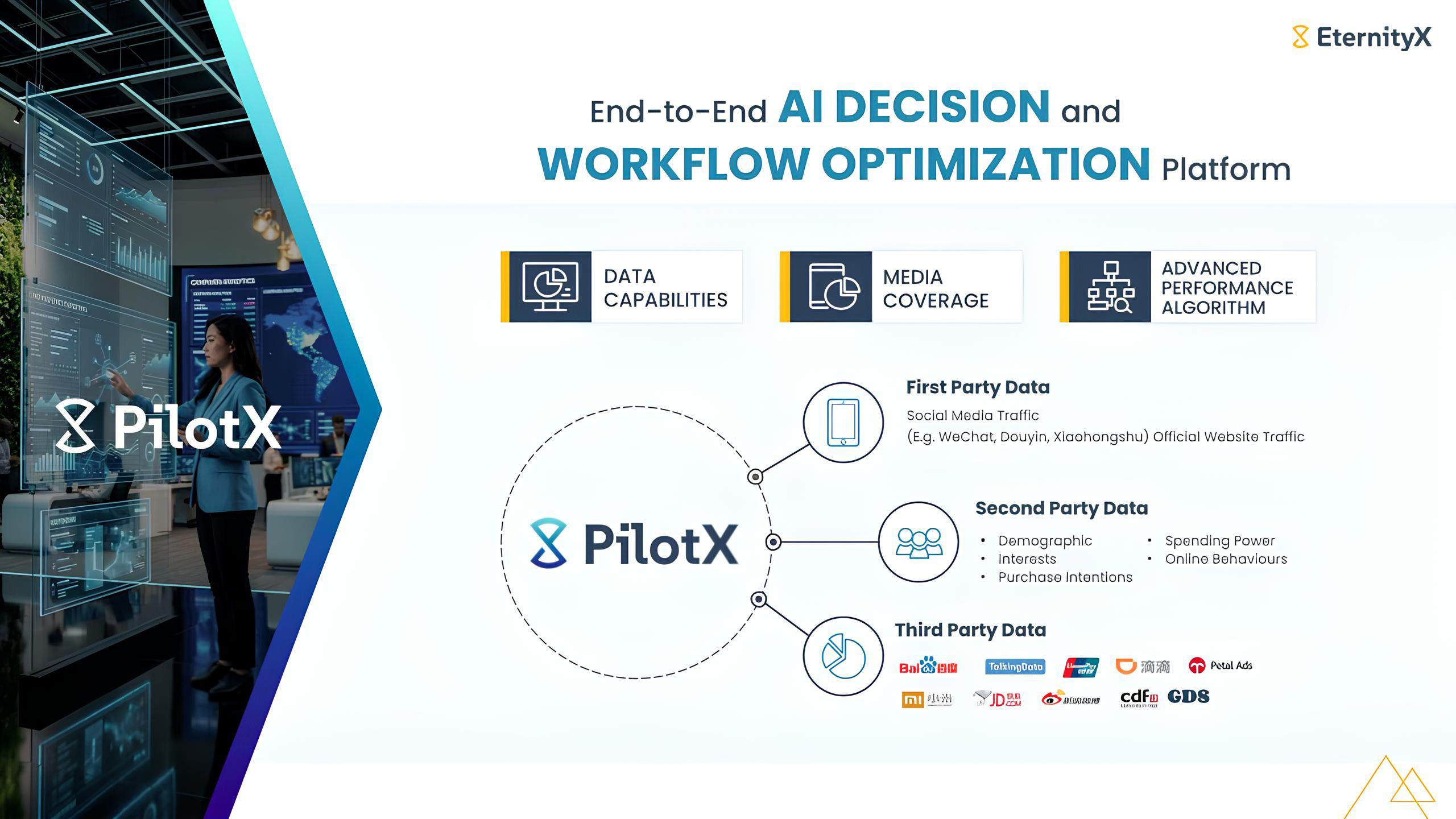
Independent and cross-border DSPs also operate — often as the layer that lets an advertiser plan and buy across several of these platforms without managing each seat separately. This is the role PilotX plays: a single programmatic console that consolidates access to China’s major platforms, WeChat, Douyin, Bilibili, Xiaohongshu, and beyond, into one portal, with ad-placement compliance and a cross-platform budget-reallocation engine built in. EternityX states that PilotX reaches roughly 98% of China’s digital consumers from that single portal, drawing targeting from its built-in DMP, ID Space.
That reach sits on deep China ad-tech engineering rather than a repurposed global stack: the EternityX team’s lineage includes building and scaling a demand-side platform from 100 million to 50 billion daily ad requests and deploying a custom data-management platform for China Merchants Bank — the kind of infrastructure a fragmented, walled-garden market actually requires.
Buying models you’ll see
The same broad models from the beginner’s guide exist in China, but the mix skews toward controlled, platform-mediated buys rather than wide-open auctions:
- Real-time bidding (RTB): Still the largest auction type by volume, but conducted within platforms rather than across an open web.
- Private marketplace (PMP) / preferred deals: Invite-based access to premium inventory — a growing share.
- Programmatic guaranteed: Fixed volume at fixed price, automated — common for big brand pushes and tentpole shopping events.
- Platform “smart bidding” / oCPX: Algorithmic optimisation toward a goal (installs, purchases, ROI) — heavily used inside Ocean Engine and Alimama.
2026 market data — and an honest word on the numbers
China is one of the largest programmatic markets in the world, but published market-size estimates vary dramatically depending on what each analyst counts as “programmatic” (whether they include retail media, walled-garden social buys, search, and so on). Rather than pick one figure, here is the range, with sources:
Market-size callout (2026 estimates — figures differ by methodology):
- GroupM ranks China the #2 programmatic market globally at ~$118 billion, behind the US.1
- Market Research Future estimates China programmatic at ~$69.6 billion in 2025, growing ~14% CAGR to 2035.2
- Grand View Research put China at ~$60.9 billion in 2023, forecasting ~23% CAGR toward 2030.3
- Narrower definitions (excluding some retail-media and walled-garden spend) land closer to ~$19.5 billion in 2025 (Mobility Foresights, 2025).4
The point isn’t the exact figure — it’s the shape: a very large market, growing double digits, mobile-first, and increasingly video- and commerce-led. (Ranges cited are third-party estimates, not EternityX data.)
1 Source: Search Lab.
2 Source: Market Research Future.
3 Source: Grand View Research.
4 Source: Mobility Foresights.
A few structural trends the sources agree on:
- Mobile-first and video-led. Screen time and short video dominate; connected TV and in-feed video are the fastest-growing formats.
- Shift toward private/permission-based deals as first-party data and identity-based targeting replace older third-party approaches.
- AI-driven bidding and optimization are now standard, not novel.
Why targeting is the hard part (and where ID Space fits)
Because audience identity is fragmented across platforms, the limiting factor in China programmatic usually isn’t buying power. It’s knowing who you’re buying.
ID Space addresses this directly: it unifies fragmented cross-channel audience data into an addressable view, so programmatic budgets are spent reaching the right people rather than the same person repeatedly across disconnected platforms. Paired with PilotX for execution, the result is programmatic buying that behaves like a single strategy instead of five separate ones.
Common myths, corrected
- Myth: “I can run my global DSP in China.” Fact: The global open-web DSP you use elsewhere generally can’t reach China’s walled gardens. You need platform access or a partner built for the China ecosystem.
- Myth: “Programmatic in China means open real-time bidding.” Fact: RTB exists, but much of the market is platform-mediated smart bidding, PMPs, and guaranteed deals inside closed ecosystems.
- Myth: “One market-size number tells me how big this is.” Fact: Estimates range from ~$20 billion to ~$118 billion depending on definitions. Read the methodology before trusting the figure.
Ready to buy across China’s platforms as one strategy? PilotX gives you a single programmatic console; ID Space makes sure you’re targeting real, unified audiences. Talk to our team.
About EternityX Marketing Technology
At EternityX, we equip brands and businesses to master the realm of Chinese audiences through the Power of Three—PilotX, NaviX, and MediaX. These cutting-edge, AI-powered solutions enable precision targeting, providing data-driven insights that allow companies to connect with profitable audiences in key markets and beyond.
With 12,000+ successful cross-border campaigns for more than 1,000 brands, EternityX helps brands unlock growth, deepen audience connections, and drive long-term success. Our expertise bridges the gap between East and West, ensuring that brands can thrive in a rapidly evolving digital landscape. Learn more about us https://www.eternityx.com.
Frequently asked questions
What is programmatic advertising in China?
It is the automated, data-driven buying of digital ads — but conducted mostly inside closed platform ecosystems (Douyin/Ocean Engine, WeChat/Tencent, Taobao/Alimama, Baidu) rather than across an open ad exchange as in the West.
Who are the biggest programmatic ad platforms in China?
ByteDance’s Ocean Engine (for Douyin), Tencent Marketing Solution (for WeChat), Alibaba’s Alimama (for Taobao/Tmall), Baidu (search), and JD and Pinduoduo (retail media) are the dominant platforms.
How big is China’s programmatic advertising market in 2026?
Estimates vary widely by methodology — from roughly $20 billion under narrow definitions to about $118 billion in GroupM’s ranking, which places China second globally behind the US. All sources agree it is large and growing double digits.
Can I use my usual Western DSP to buy media in China?
Generally no. Standard open-web DSPs can’t reach China’s walled-garden platforms. You need direct platform seats or a China-capable programmatic partner such as PilotX.




 As Founder and CEO of EternityX Marketing Technology, Charlene is a pioneering leader in the digital marketing landscape, dedicated to driving growth and innovation. Her role encompasses overseeing the strategic direction of the company, with a strong emphasis on connecting brands to the Chinese market and enhancing their engagement with diverse audiences. Charlene’s unique expertise in digital business allows her to identify key opportunities and efficiently allocate resources, ensuring that brands not only thrive but also build authentic connections with their target markets.